Emir H
Amazon PPC for agencies
I run the ads. You keep the relationship.
A senior specialist you can bring on tomorrow - no job posting, no interviews, no training.
How this works
The mindset
What's underneath the numbers.
Treat every account like it's my own
It doesn't matter whose account it is, or how long we've worked together - the attention is the same. I run every one the way I'd run my own business.
Consistency over momentum
Good months don't change how the next one gets run. The process stays the same whether an account is up, flat, or working through a rough patch.
No such thing as a minor detail
An account rarely goes wrong all at once. It slips one overlooked detail at a time.
Simplicity before complexity
Sophistication in PPC isn't more moving parts. It's the discipline to keep things only as complex as they need to be.
What this has looked like in practice
Different problems. Different answers.
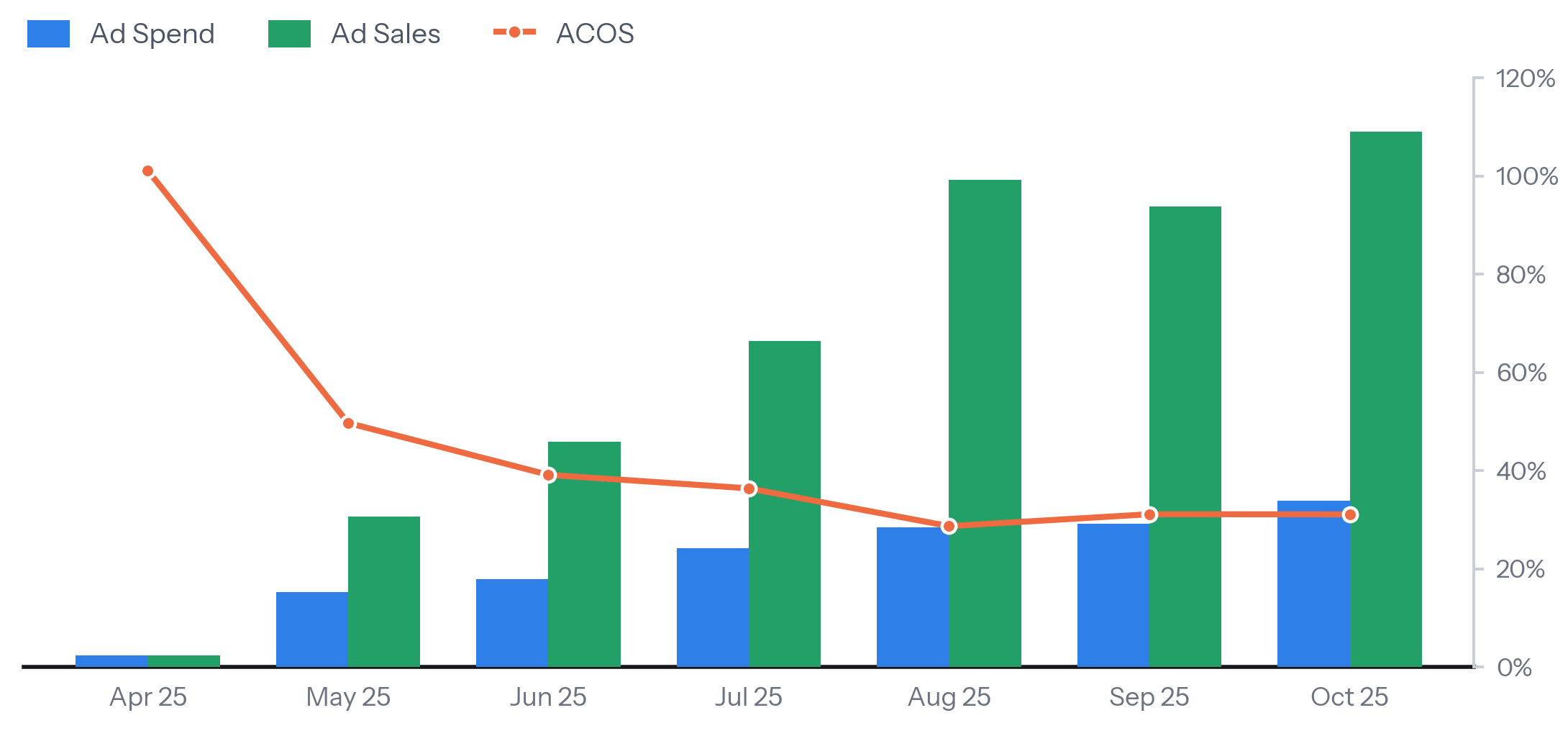
Beauty · United StatesNew products, no reviews, no rank - and a 101% ACOS in month one. Six months later, every dollar was buying three times the revenue.
A US beauty brand launching several new products into one of the most aggressively contested categories on the platform, against established sellers with deep budgets and years of ranking history.
New listings: no reviews, no rank, no conversion data - and a brand almost nobody was searching for yet, which meant virtually everything had to be won on non-branded traffic, at non-branded prices. Margins were thin enough that a sustained triple-digit ACOS would have ended the launch before it started. The first month of real traffic came in at 101% ACOS - every dollar of revenue costing a dollar of ad spend.
The first month was deliberately underfunded. In a category this expensive, buying data at scale before you know what converts is the fastest way to burn a launch budget - so the account stayed small and bought its data cheaply while the listings were still unproven.
Budget went in only once the account had earned it - behind the products that had demonstrated they could convert, not spread evenly across the range. From there the work compounded: each month's increase in spend was funded by the efficiency the month before had produced, so the account was never scaling on borrowed confidence.
ACOS fell from 101% to 31% over six months. From the first full month at scale, ad sales grew 3.6× while spend grew 2.2× - the account was buying substantially more revenue per dollar at the top than at the bottom.
The final two months are worth being straight about. Efficiency stopped improving and settled around 31%, and the category softened. I kept pushing spend through both - 19% more across those two months - because the account was profitable at that level, and the alternative was protecting a percentage at the cost of volume the brand needed. That was a decision, not a drift.
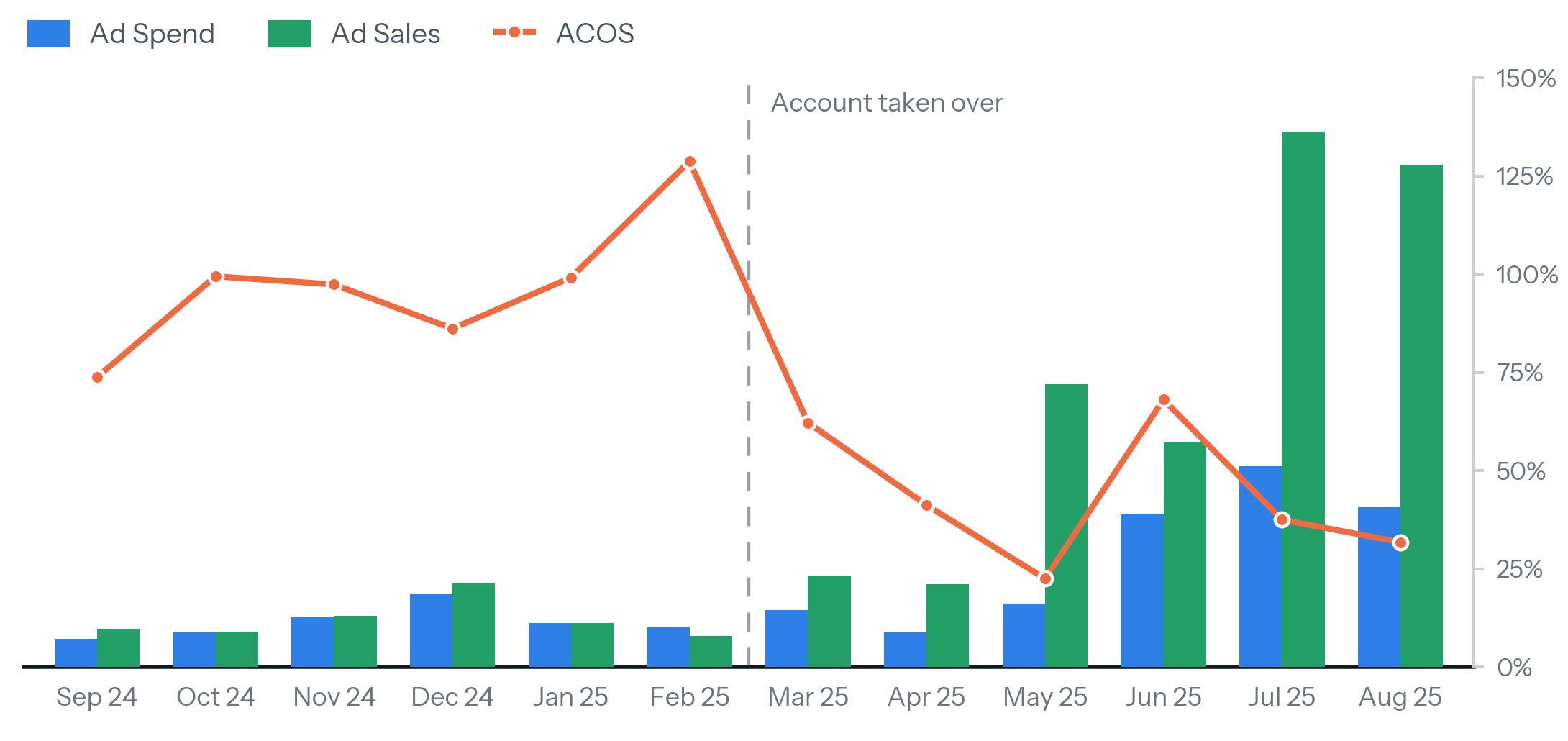
Grocery · ItalyA euro back for every euro spent. Six months later: six times the sales, at less than half the cost per sale.
An Italian grocery brand in a category locked up by established sellers with years of ranking history behind them. I took the account over in March 2025, after six months in which it had spent almost exactly as much as it had earned.
A blended 95% ACOS across the half-year before I inherited it, and 129% in the final month - a euro of spend for a euro of revenue, on grocery margins. The brief pulled in two directions as well: the client's stated priority was visibility first and sales second. That is a reasonable thing to want, and an expensive thing to want, in a category where the incumbents can outbid a challenger indefinitely.
The rebuild was about measurement, not tidiness. The account was fragmented until every distinct buying behaviour had its own place to sit and its own budget to defend - granular enough that it could prove things rather than argue about them. The large mayority of the keyword targeting was non-branded - in a category owned by incumbents, the brand's own name was never where the growth was going to come from.
That mattered specifically because of the visibility brief. The client wanted to push into formats I had doubts about. Rather than resist it, I built an account that could answer the question with evidence instead of opinion - so the push went ahead, properly funded and properly isolated.
It didn't work. It never worked. In the month it ran unchecked, spend more than doubled and ad sales fell. But because it was isolated, the failure was provable in four weeks rather than diffused across the account for a year - and once proven, it could be contained. The client kept asking for visibility. Each time it ran, it was killed earlier, and the conversion side was pushed harder to carry it.
Across the six months before I took over, the account ran at a blended 95% ACOS. Across the six months after, 38.8% - with ad sales up 6× against a 2.5× increase in spend. Six months either side, everything included, nothing selected.
The sharpest evidence sits in two adjacent months. In the one month the visibility formats weren't running, the account returned at 22.5% ACOS. The following month, with them running unchecked, it returned at 68.1% - on more than double the spend. The account proved its own client's brief wrong, in writing, in four weeks.
By August it was carrying more than three times its previous monthly spend at a third of its previous ACOS - while still absorbing the visibility spend the client insisted on. That is the part worth noticing. The search build was strong enough to win with a hand tied behind its back.
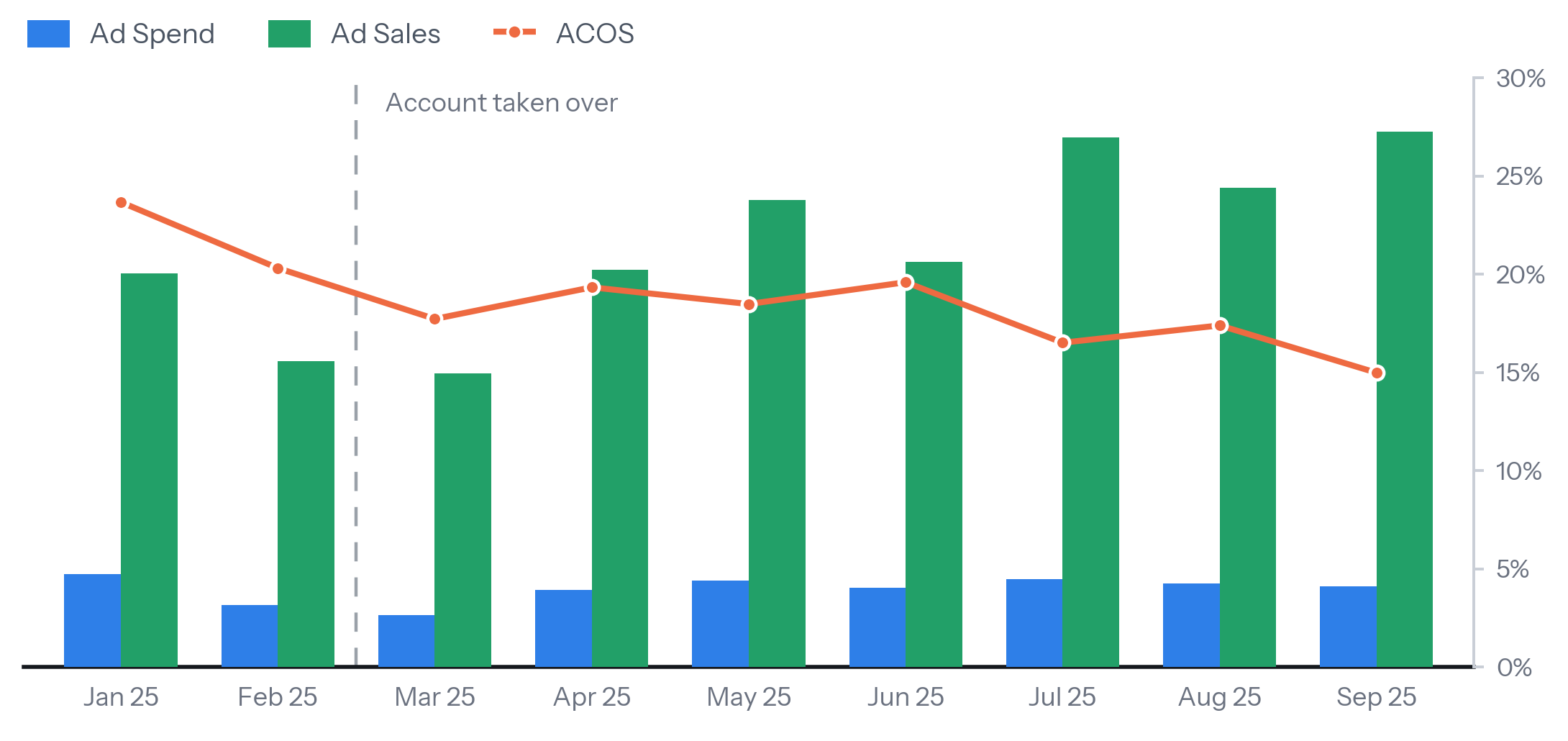
Beauty · AustraliaThe account wasn't broken, so I didn't rebuild it. What followed: less spend, more sales, better margins.
An Australian beauty brand, inherited in March 2025. The client wanted growth without giving up profitability - the thing every advertiser asks for and few accounts are built to deliver.
The account wasn't broken, and that was the awkward part. Nothing was on fire, the numbers looked defensible, and there was no obvious villain to point at. Accounts like this are where money disappears quietly - not through catastrophe, but through a long tail of spend nobody has had the time to interrogate. The temptation on inheriting one is to rebuild it. It looks decisive, it justifies the handover, and it is very often the wrong call.
I didn't restructure it. The account's bones were sound. What it lacked was someone willing to be ruthless about what wasn't working and patient about what was.
The first month was a subtraction. Unprofitable campaigns and targets came out, and the account spent 16% less as a result - while ad sales fell under 4%. That gap is the whole argument: almost everything I removed had been buying almost nothing. It also settled the question before any money went back in, which meant the growth that followed was built on a base that had been proven rather than assumed.
After that, the work was unglamorous and continuous - fund what converts, cut what doesn't, and do it weekly rather than quarterly. There was no clever restructure. There was attention.
The cleanest measure is a like-for-like month. January, before I took over, ran at 23.7% ACOS. September ran at 15.0% - on 14% less spend and 36% more ad sales.
Across the seven months I ran it, blended ACOS improved from 22.2% to 17.6%, with monthly ad sales averaging 27% higher on an unchanged average monthly spend.
More profitable, at greater volume, for the same money - and structurally the same account I inherited.
“Two accounts with him since 2023.”
— Agency owner, UK
Questions you may have
The ones that tend to come up on a first call, answered up front.
Will you try to take my clients?
No. I'll sign a non-solicit before touching an account - and I'd rather keep the partner than take the client.
Will my client know you exist?
No. Your brand, your relationship, your calls. I stay entirely behind the scenes.
What does it cost?
Everyone's favorite answer in PPC is "it depends" - and here it genuinely does, on ad spend and catalog size.
Do you run ads on other platforms too?
Amazon only. It's the one place I go deep rather than spread thin.
What's the commitment?
Month-to-month, no lock-in - thirty days' notice on either side if it's not working out.
What's your availability?
I take on only as many accounts as I can genuinely stay on top of. When I'm full, I say so - rather than take the work and duct-tape it.
How do we work together day to day?
Email or Slack, with a reply inside a business day, plus one monthly call to touch base. Weekly briefs per account and a full monthly report, ready to send under your name.
What timezone are you in?
CET, but I don't work synced hours with anyone, so in practice it rarely ends up mattering.
What happens if you're away?
Zero outsourcing - I don't let anyone into the accounts. Planned time away comes with at least 5 days' notice, and while I'm out I check in a few times a week to catch anything that needs immediate action.
How do we start?
We begin with a 30-minute call covering your setup, our partnership and my pricing. If it's a fit, we sign and set a start date that works for both of us. If you'd rather see it in action first - I'll conduct the audit, credited fully against your first invoice.
Emir H · Amazon PPC for agencies
All figures shown are real and verifiable against the account.